Hearts, Minds & Making a Difference: YPI meets RME at Inverkeithing High by Celia Newton

YPI has gained considerable traction since its launch in 2008, approximately 300 schools now participate. We will look at the delivery of YPI in RME considering the aims of YPI, teaching and learning approaches within RME, encouraging active engagement with pupils, supporting the delivery of the “Values in Action” unit and “troubleshooting” concerns around its delivery. This workshop will support teachers who are running YPI, or supporting other departments doing so, whether they are seasoned veterans or newbies, hopefully giving some inspiration to take back to the classroom!

By STARMEadmin, ago

Introducing STARME Speed Meets

As Announced at the Festival of Learning our Teach Meet Programme currently has 40 members signed up across the country. Introduced in 2024 to respond to member requests for more frequent high-quality CLPL around the teaching of RME/RERC/RMPS.  Current Regional Teach Meets include: Teach Meets are centred on member requests Read more

By STARMEadmin, ago

Secondary school student perceptions of RMPS in a secular society by Rhianna Stewart

With Scotland becoming an ever increasingly secular society, the place for RMPS in the secondary school curriculum has become increasingly questioned. My research explores the extent of which secondary students believe RMPS contributes to their understanding of contemporary social and ethical issues in a secular society, factors which influence their perception of the subject and if students perceive RMPS as contributing to their personal development and moral reasoning.

By STARMEadmin, ago

Using Dilemma Discussions in Moral Education in Primary Schools by Chantelle Boyle

Moral education is most effective when based on discussions and debate (Kohlberg and Hersh, 1977) but that can often be a challenge in the primary classroom. Time can be a barrier to exploring moral education topics (Clanachan and Matemba, 2015). But even as little as 10 minutes per day can be beneficial to students’ moral development. In this session, we will explore the use of dilemma discussions where free video resources will be shared that have been developed from my PhD research.

By STARMEadmin, ago

Teaching About Judaism by Sydney Switzer, Jewish Council of Scotland

This This session will provide an overview of relevant Jewish topics and traditions, as well as looking at challenges that can come up when teaching about Judaism. We will be exploring some resources from the Jewish Council of Scotland which can be used in a classroom setting, and will have an opportunity to ask questions as well. We will also discuss how to support Jewish students and families in the classroom.

By STARMEadmin, ago

Introducing N5/Higher Philosophy in Secondary Schools by Jonas Christensen

This session aims to give share some experiences about how to successfully introduce SQA certificate Philosophy classes secondary schools. This will include suggestions on how to give pupils the best chance of attaining and addressing some worries that schools (or teachers) might have, such as whether philosophy will cannibalise RMPS and whether there’s a pathway from Higher Philosophy to Advanced Higher RMPS.

By STARMEadmin, ago

An innovative approach to critical thinking and analysing world religions, with S1 by Adam Bisset

Our existing S1 course focused on “feeding facts” and testing memory, so I designed two new units: a first which broke critical thinking down into 5 BGE-friendly basic questions (with tie-ins to the signposting language of senior-phase analysis) and a second which applied and assessed these skills with respect to 7 world faiths. An innovative method for classifying religions was developed.

By STARMEadmin, ago

A religion and worldviews approach to RME/RE by Fiona Moss

In this insightful session, Fiona Moss, Education and Programs Manager for Culham St Gabriel’s, delves into the “religion and worldviews” approach to Religious and Moral Education (RME) and Religious Education (RE). Drawing on her extensive experience, including her past roles with RE Today and the National Association of Teachers of RE, Moss outlines the origins and key tenets of this evolving pedagogical framework. She highlights its continuity with established scholarship (e.g., Robert Jackson, Andrew Wright) while emphasizing its departure from the traditional “world religions paradigm” to better reflect diverse lived experiences and changing demographics. The discussion differentiates between organized and personal worldviews, using compelling examples like the “Picturing Islam, Picturing Muslims” resource to illustrate the practical application of this approach in challenging stereotypes and fostering deeper understanding. Moss further explores substantive content and pedagogical methodologies, offering concrete examples, such as how to move beyond superficial mosque studies to a more nuanced exploration of location, voices, and diversity. The session concludes with practical advice on language use in the classroom and the importance of acknowledging the messy, overlapping nature of real-world beliefs, demonstrating how this approach empowers pupils to become responsible interpreters of diverse worldviews.

By STARMEadmin, ago

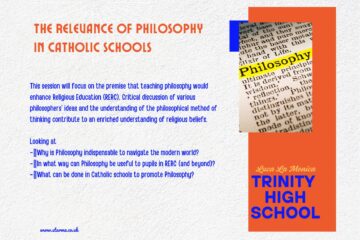
The Relevance of Philosophy in Catholic Schools by Luca La Monica

My session will focus on the premise that teaching philosophy would enhance Religious Education (RERC). Critical discussion of various philosophers’ ideas and the understanding of the philosophical method of thinking contribute to an enriched understanding of religious beliefs. My presentation will address the following points: – Why is Philosophy indispensable Read more

By STARMEadmin, ago