RMPS in the News: Can Justice Include Mercy?
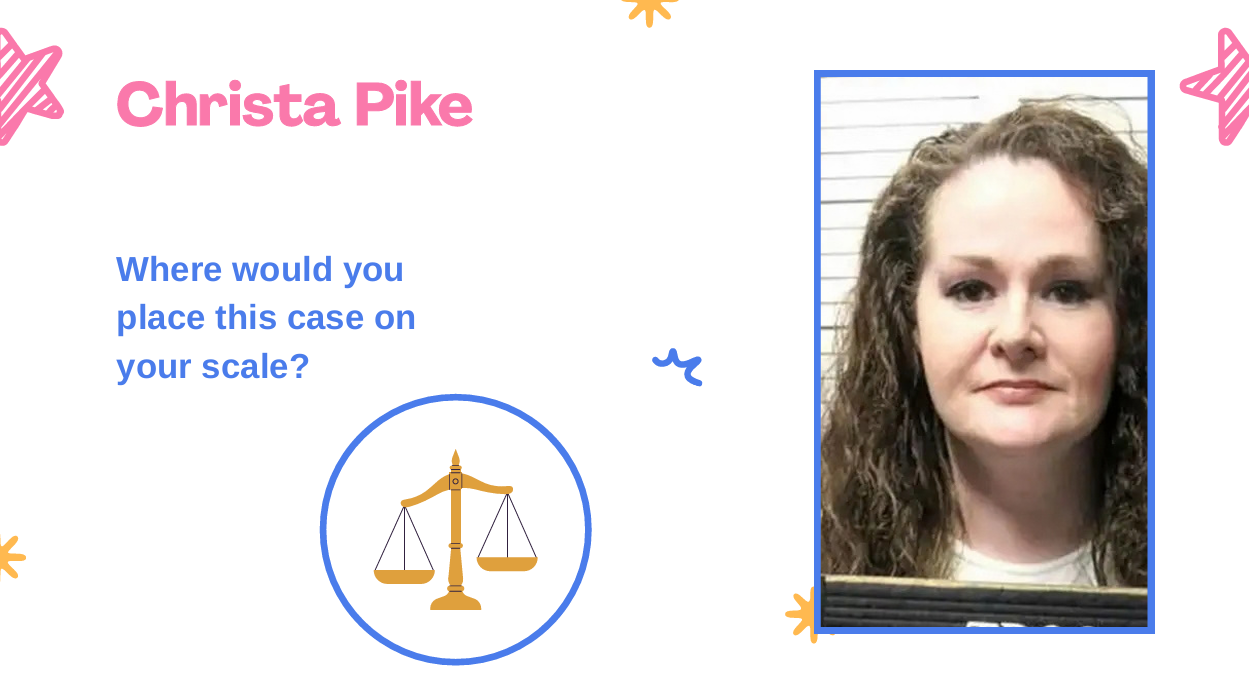
The death penalty is once again making headlines in the United States. Christa Pike, who is currently the only woman on Tennessee’s death row, is scheduled to be executed 30th September 2026. If the execution goes ahead, she will be the first woman to be executed by the state in over 200 years.
Christa Pike was convicted for murder of 19 year old Colleen Slemmer in 1995, when she was 18 years old. Pike does not deny her responsibility for the murder. Her lawyers and supporters have argued that her age at the time of the crime, childhood abuse and other circumstances should be considered when making the decision about carrying out the death sentence. Coleen Slemmer’s mother supports the execution.
This case brings a difficult RMPS question into the real world: What should justice look like when someone has committed a serious crime?
Why does this issue matter?
The death penalty raises some of the biggest questions we explore in RMPS:
If someone deliberately takes another person’s life, should the state have the right to take theirs?
This also gives learners the opportunity to explore:
– Retribution: should punishment give offenders what they deserve?
– Deterrence: can punishment prevent future crime?
– Protection: does society need protection from certain offenders?
– Reformation: can people change?
– Justice and mercy: can both exist together?
– Human dignity: does every person retain value, even after committing a serious crime?
How can I use it in the classroom?
This topic could provide an engaging introduction to crime and punishment or support previous knowledge on punishment and the purposes of punishment.
Activity Examples


Activity 1: The Justice Scale
Have this statement on the board: “Justice means giving people what they deserve”.
Give learners a piece of paper and ask them to draw a scale.
On one side, they write arguments for justice as punishment. On the other, arguments for justice as mercy/reformation.
Introduce the Christa Pike case. Ask: Where would you place this case on your scale? Why?
The important point is not to reach a class consensus, but to explore WHY different people understand justice differently.
Activity 2: The Four Corners Debate
Put four statements around the classroom:
A. The death penalty is always wrong.
B. The death penalty can sometimes be justified.
C. It depends on the circumstances of the crime.
D. I need more information before I can decide.
Read out the statement: “The state should never take a person’s life as punishment.”
Learners move to the corner that best represents their initial response.
Give each group time to develop three reasons for their position.
Then introduce different perspectives, such as:
– Christian teachings on forgiveness and the sanctity of life
– Islamic teachings on justice, mercy and forgiveness
– Humanist arguments about human dignity and the right to life
– Retributivist arguments about proportional punishment
– Utilitarian arguments concerning consequences and deterrence
– Learners can then move corners if their thinking has changed.
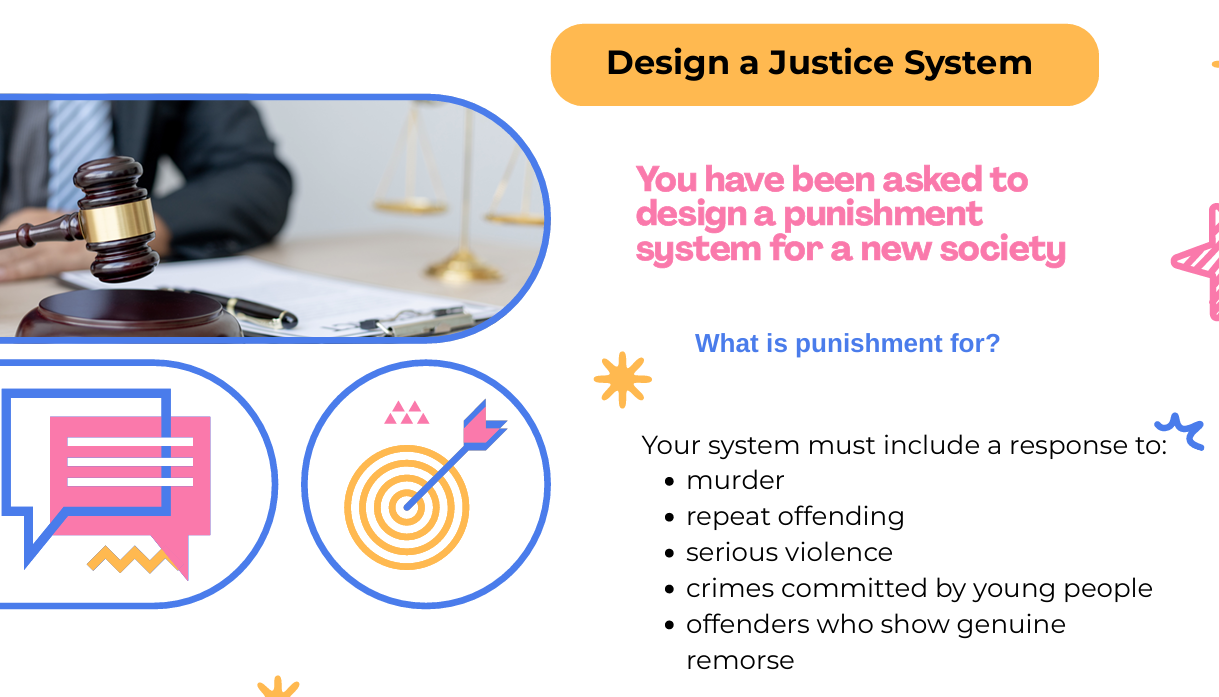
Activity 3: Design a Justice System
Give groups the challenge: “You have been tasked to design a punishment system for a new society”.
They must decide what is the punishment for?
Their system must include a response to:
– murder
– repeat offending
– serious violence
– crimes committed by young people
– offenders who show genuine remorse
Groups create a “Justice Charter” containing 5 principles.
For example:
Principle 1: Punishment should protect society.
Principle 2: Everyone should have the opportunity to change.
Groups then compare their systems with the purposes of punishment studied in RMPS.
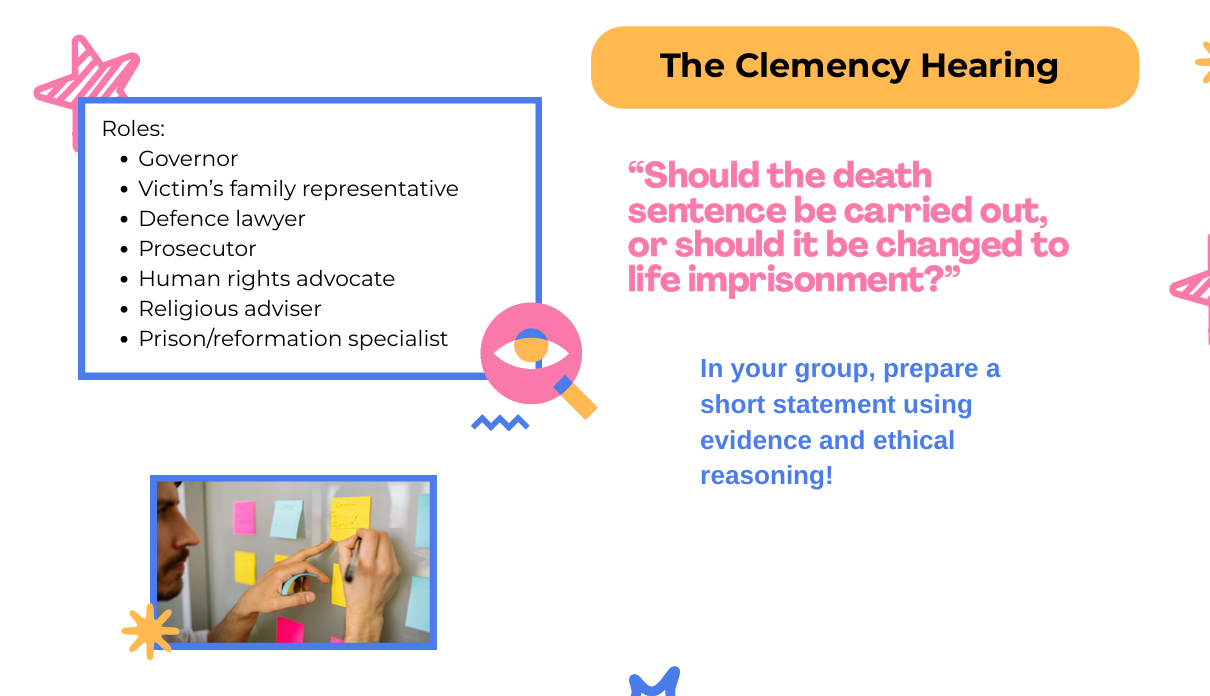
Activity 4: The Clemency Hearing
For a more creative task, hold a fictional clemency hearing.
Different groups take on roles such as:
– Governor
– Victim’s family representative
– Defence lawyer
– Prosecutor
– Human rights advocate
– Religious adviser
– Prison/reformation specialist
The question before them is:
“Should the death sentence be carried out, or should it be changed to life imprisonment?”
Each group must prepare a short statement using evidence and ethical reasoning, rather than simply saying what they personally feel.
The “Governor” then explains which arguments they considered most significant.

Impact on Learning
Using a current case such as this makes the issue of punishment more than something written in a textbook.
Learners can see that the questions they discuss in RMPS, such as justice, mercy, forgiveness, human dignity, and the purpose of punishment, have real consequences for people’s lives.
It also provides an opportunity to model something something particularly important in RMPS: being able to understand an argument without necessarily agreeing with it.
The aim isn’t simply to ask learners: Are you for or against the death penalty?”. Instead we ask: “What does justice require and why?”.